NVIDIA Chimera: A Quantum Leap for AI Hardware?
Is Classical AI Hitting a Wall?
Did you know that some of the world’s most complex problems, like optimizing global shipping routes or discovering new life-saving drugs, can take today’s best supercomputers weeks or even years to solve? This computational limit is a major barrier. At its 2025 keynote, NVIDIA announced a potential solution that sounds like science fiction: the NVIDIA Chimera project. This isn’t just another GPU; it’s the first commercially available hybrid quantum-classical AI chip, and it promises to tackle these ‘unsolvable’ problems.
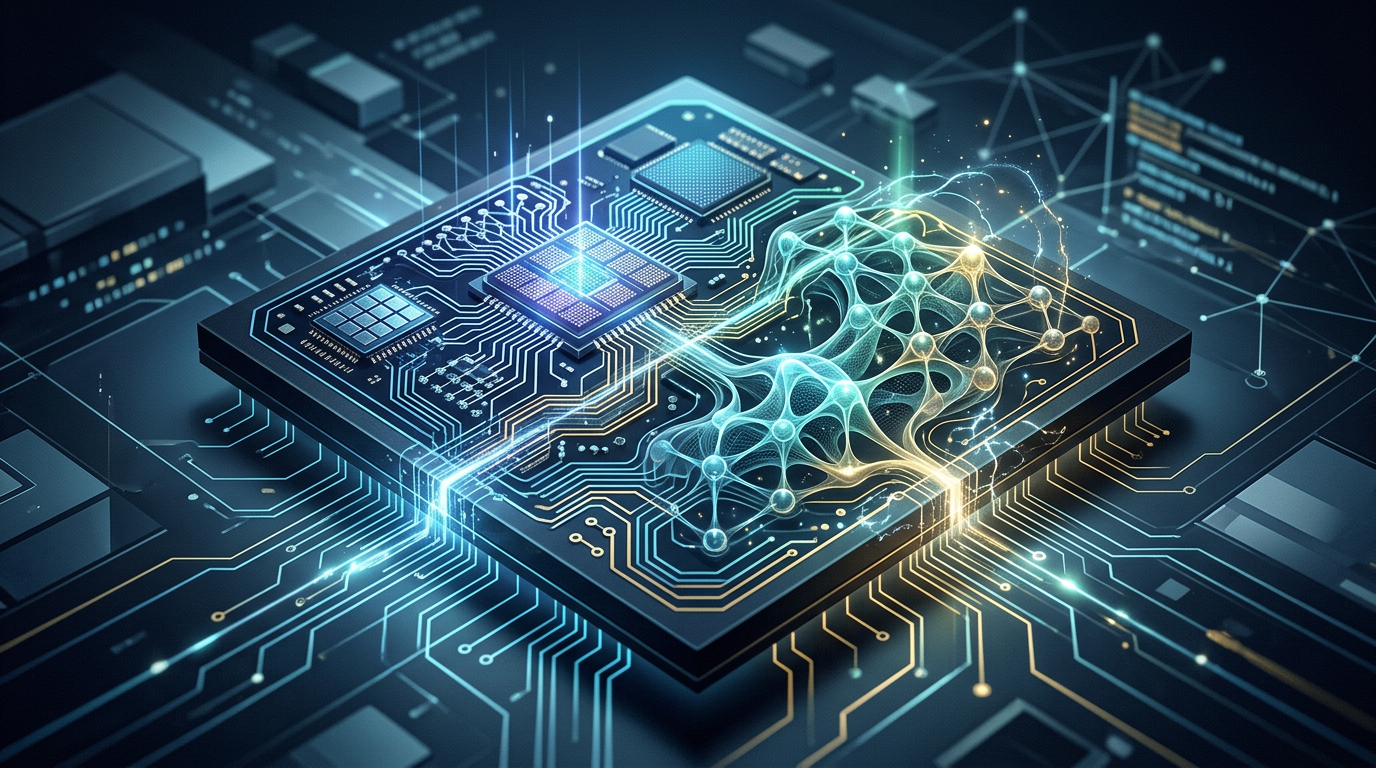
The first chip in this new line, the C-100 Hybrid Processing Unit (HPU), integrates a quantum processor directly with classical AI cores. NVIDIA claims this new AI hardware can deliver up to a 1,000x performance increase on specific tasks. But what is this new chip, and will it really change the game for AI?
What’s Inside the NVIDIA Chimera C-100?
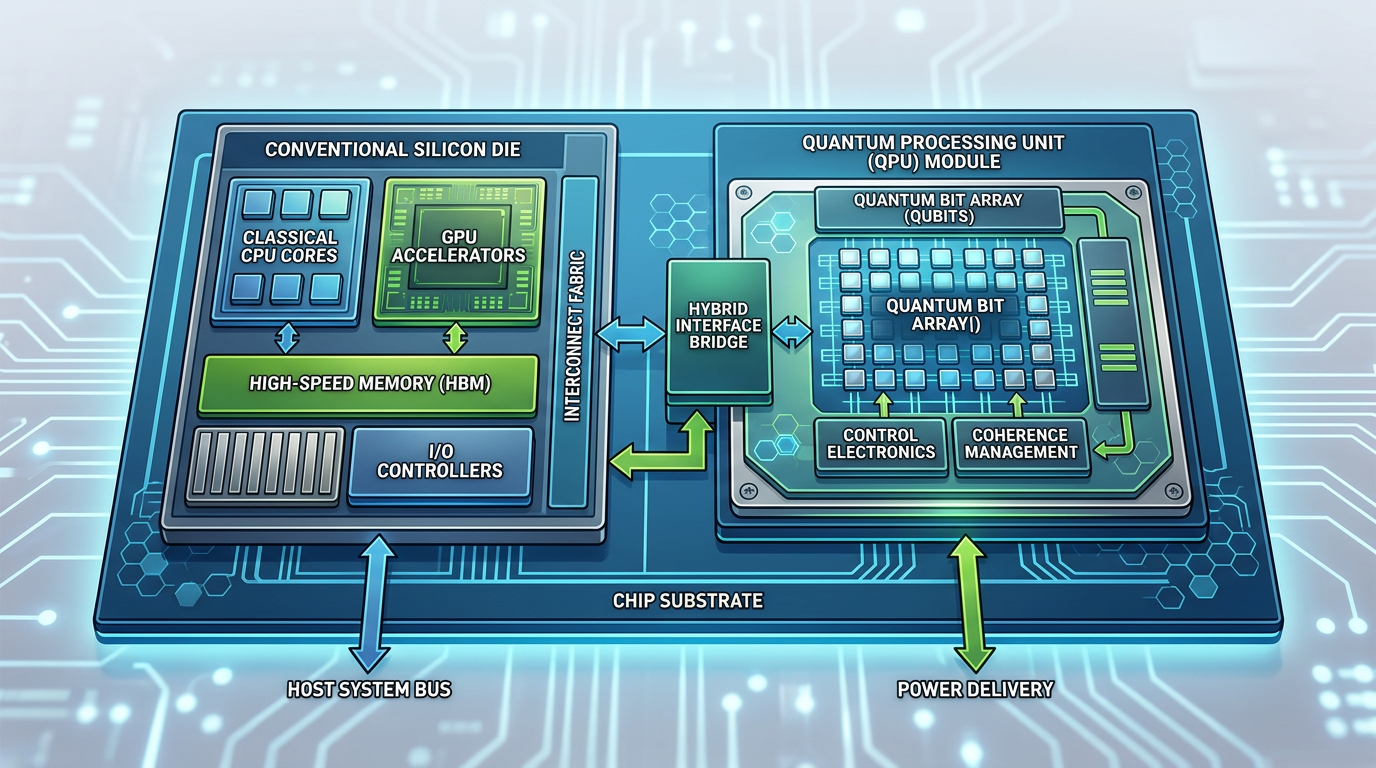
The C-100 isn’t a simple upgrade. It’s a whole new type of processor. Think of it as a team of specialists on a single chip. Here are the main parts that make the NVIDIA Chimera work.
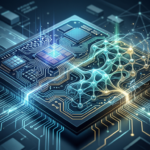
- Hybrid Processing Unit (HPU) Architecture: The core idea is putting two different types of processors together. The C-100 HPU has thousands of NVIDIA’s traditional CUDA cores, great for standard machine learning tasks, sitting right next to a brand new Quantum Processing Unit (QPU) on the same piece of silicon. They work together, passing tasks back and forth instantly.
- Photonic Quantum Processing Unit (QPU): This is the real star. Unlike most quantum computers that need to be supercooled to near absolute zero, the Chimera’s QPU uses photonic qubits. This means it uses particles of light to perform quantum calculations and can operate at room temperature. It’s not a general-purpose quantum computer, but a specialized accelerator designed for optimization and simulation.
- The QuantumNet SDK: Hardware is useless without software. The QuantumNet Software Development Kit is the bridge that lets developers use this new power. It plugs directly into existing AI frameworks like PyTorch and TensorFlow, allowing a developer to ‘offload’ a particularly hard part of their code to the QPU with just a few new lines of code.
As for alternatives, you could look at pure-play quantum companies like IonQ or Rigetti, but their systems are standalone machines in a lab, not an integrated chip you can put in a server rack. D-Wave’s quantum annealers are another option, but they are also specialized and not integrated in this hybrid way.
How Long to Get Started with Quantum AI?
Adopting the NVIDIA Chimera isn’t like just upgrading a graphics card. The time it takes will depend on your team’s goals and skills.
For an experienced AI developer already comfortable with Python and TensorFlow, learning the basics of the QuantumNet SDK could take a few weeks. The syntax is designed to be familiar. However, the real time investment comes from learning to think in a ‘quantum’ way. Identifying which parts of a problem are suitable for the QPU and framing them correctly could take months of work for a new project.
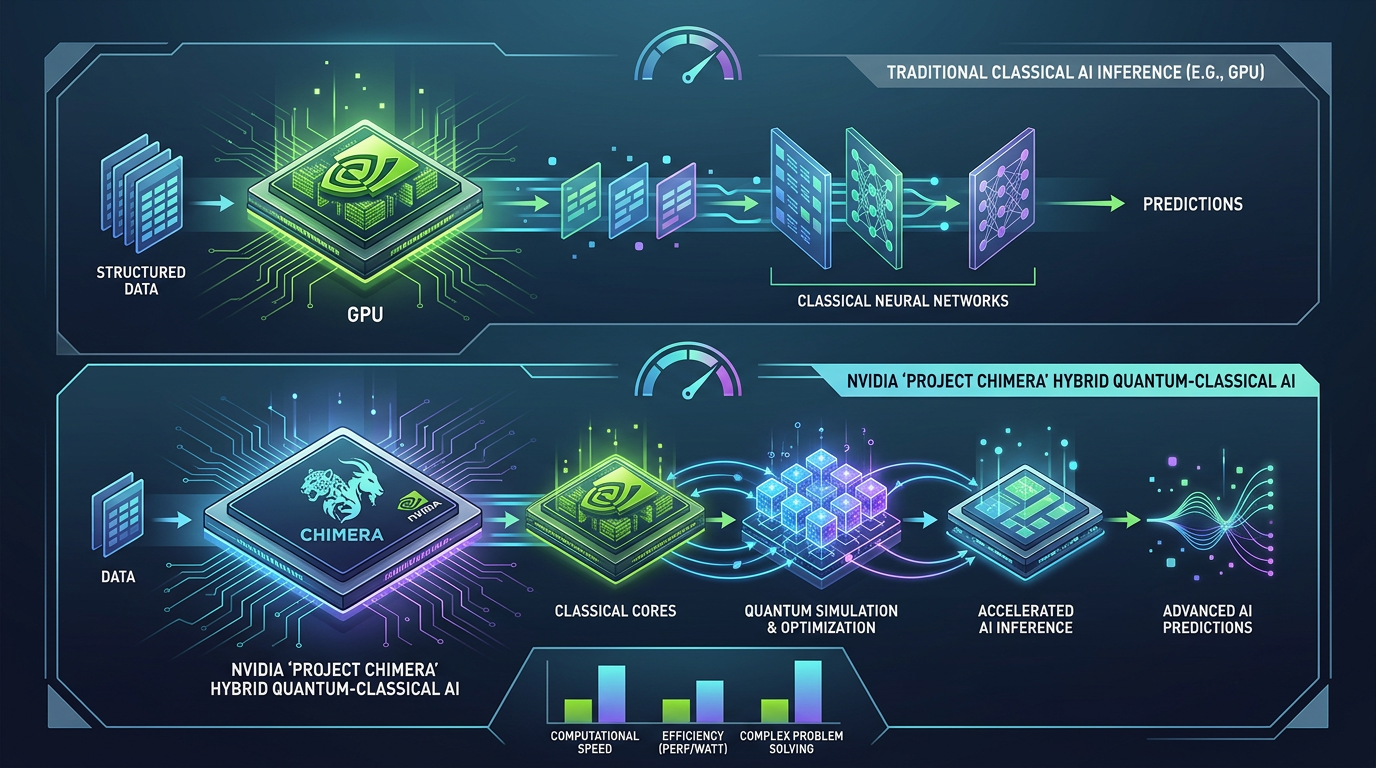
Where you see the massive time savings is in execution. A complex protein folding simulation that might take a cluster of H100 GPUs two weeks to complete could, according to NVIDIA’s benchmarks, be finished on a single C-100 HPU in under 30 minutes. The prep time is longer, but the payoff in calculation speed is enormous for the right kind of problem.

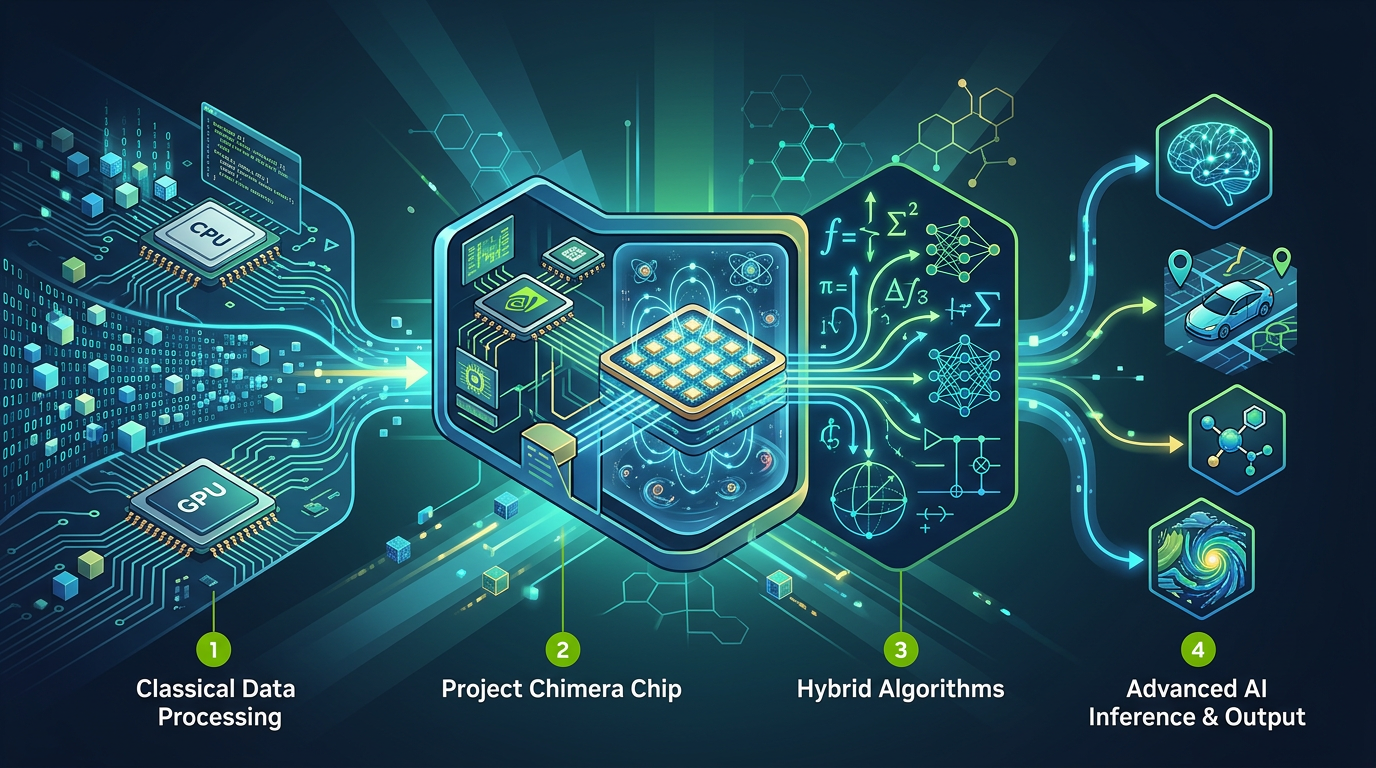
Step 1: Install the QuantumNet SDK
Getting the software is the easiest part. NVIDIA has made it available through standard package managers. You would open your terminal in your development environment and run a simple command similar to this: pip install quantumnet-nvidia. This installs the necessary libraries to let your Python code talk to the C-100 HPU.
Step 2: Identify a Quantum-Suitable Problem
This is the most important step. Don’t try to run your entire large language model on the QPU; it won’t work. The QPU is a specialist. Look for problems related to complex systems, routing, scheduling, or molecular simulation. A good example is finding the most efficient route for a fleet of 500 delivery trucks, a classic optimization challenge that gets incredibly hard for classical computers to solve perfectly.
Step 3: Define Your Hybrid Model in Code
Within your existing PyTorch or TensorFlow code, you’ll use the QuantumNet SDK to define a ‘quantum layer’. It might look something like this: you build your standard neural network, but for one specific, complex calculation, you wrap it in a quantumnet.QuantumLayer function. This tells the C-100 to send that part of the job to the onboard QPU, while the CUDA cores handle everything else.
Step 4: Execute on the C-100 HPU
When you run your model, the QuantumNet SDK and the NVIDIA driver handle the complex work of routing tasks. You simply specify the C-100 HPU as your target device. The classical parts of the model run on the CUDA cores, and when the execution hits your QuantumLayer, the data is passed to the QPU. The QPU runs its calculation and passes the result back to the CUDA cores to continue the process. From a high level, it feels like using another co-processor.
Step 5: Analyze the Quantum-Enhanced Results
The output from the QPU might not be a single, perfect answer. Due to the nature of quantum computing, you might get a probability distribution of very good potential solutions. Your final step is to analyze these results. For the delivery truck problem, this might mean getting the top 5 most efficient routes, all of which are better than what a classical computer could find in the same amount of time.
Key Metrics: C-100 HPU vs. B200 GPU
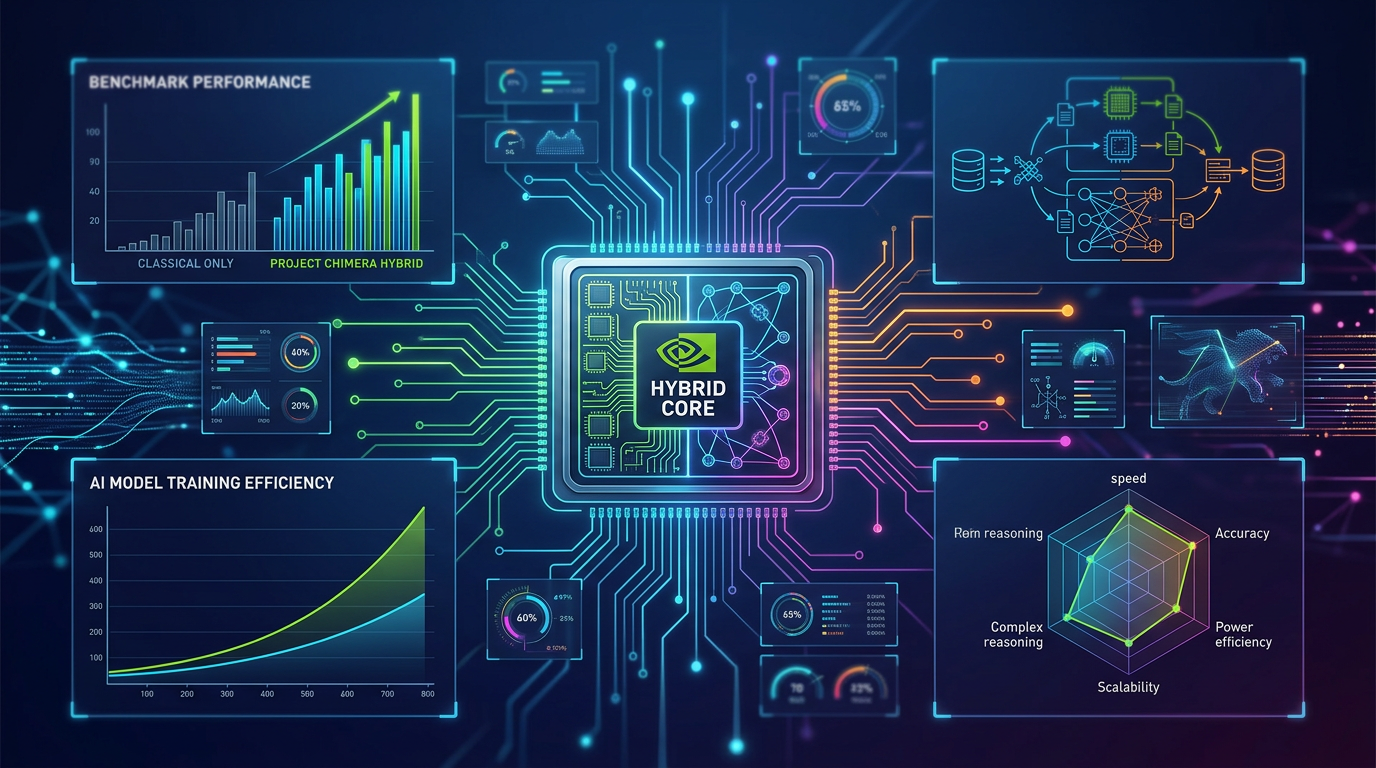
NVIDIA’s keynote presented some big claims, comparing the new C-100 HPU against their current top-tier AI workhorse, the B200 GPU. The data focuses on problems where quantum methods have a theoretical advantage. Here’s a summary based on their initial findings.
| Problem Type | NVIDIA B200 (Classical) | NVIDIA Chimera C-100 (Hybrid) | Performance Gain |
| Traveling Salesman (500 cities) | ~48 hours | ~3 minutes | ~960x |
| Drug Discovery (Molecular Docking) | ~14 days | ~20 minutes | ~1,008x |
| Portfolio Optimization (1000+ assets) | ~72 hours | ~5 minutes | ~864x |
| Energy Usage (per solution) | ~90 kWh | ~1.5 kWh | 60x more efficient |
Data sourced from NVIDIA’s 2025 keynote presentation and technical briefs. Performance gains are approximate.
These numbers show that for its target audience, the NVIDIA Chimera isn’t just a bit faster; it represents a fundamental change in the time and energy required to find solutions.
Are There Other Ways to Access Quantum Power?
The C-100 is a new and expensive piece of AI hardware. So, what are the other options if you want to explore hybrid quantum computing?
- Cloud Quantum Services: Companies like IBM, Google, and Amazon offer access to their quantum computers through the cloud. You can send problems to their machines for a fee. The downside is that it’s not integrated. You have high latency sending data back and forth, making it unsuitable for the tight integration seen in the NVIDIA Chimera.
- Quantum Annealers: D-Wave Systems specializes in quantum annealers, which are very good for optimization problems. This is a strong alternative for logistics or finance companies. However, they are less flexible than the Chimera’s HPU architecture and are separate, large systems.
- Classical Emulation: You can use powerful classical computers to simulate a small quantum computer. This is great for learning and development, as it’s very cheap. The problem is that it doesn’t scale. Simulating even a few dozen qubits requires a massive amount of classical memory and processing power, making it too slow for real work.
Who Will Use the NVIDIA Chimera?
The first wave of C-100 users will be organizations with huge, complex problems and the budget to match. NVIDIA has already announced key partnerships that show where this technology is headed.
Pharmaceuticals and Life Sciences: A partnership with Roche aims to speed up drug discovery. The C-100’s QPU can model molecular interactions at a level of detail that is impossible for classical computers. This could help scientists find new drug candidates in a fraction of the time, potentially saving billions in R&D.
Logistics and Supply Chain: Global shipping giant Maersk is another launch partner. They plan to use the NVIDIA Chimera to solve their fleet routing problems. Optimizing thousands of ships and containers across the globe is a perfect task for the QPU, where even a 1% efficiency gain can translate to millions of dollars in fuel savings and reduced emissions.
Financial Services: While no specific bank was named, the finance industry is a prime market. The C-100 could be used for real-time portfolio optimization and complex risk analysis, giving firms a significant competitive edge.
Common Mistakes to Avoid with Hybrid Quantum AI
Jumping into a new field like this comes with pitfalls. Here are some common mistakes teams make when first working with a quantum AI chip.
1. Using it for the wrong problem. The biggest mistake is treating the C-100 like a faster GPU. Trying to use the QPU for image recognition or running a standard chatbot will be slower and less effective than using just the CUDA cores. It’s a specialized tool for a narrow set of problems.
2. Ignoring problem formulation. You can’t just feed data to the QPU. I’ve seen teams spend 90% of their time trying to get a model to work, only to realize the core problem wasn’t framed in a way a quantum processor could understand. The setup is more important than the execution.
3. Expecting perfect, deterministic answers. Quantum computers work with probabilities. The QPU will give you a set of highly probable, excellent answers, not always one single ‘perfect’ one. If your workflow requires absolute certainty every time, this might not be the right tool.
Best Practices for Long-Term Success
To get real, lasting value from an investment in the NVIDIA Chimera, organizations need a clear strategy. This isn’t plug-and-play.
First, build a hybrid team. You need your best machine learning engineers working alongside people who understand quantum mechanics or have a strong physics background. This collaboration is key to translating business problems into a format the QPU can solve.
Second, start with well-defined problems. Before trying to cure cancer, use the C-100 to solve a known optimization problem in your business. Get a win, show the value, and build expertise within the team. This iterative approach builds momentum and internal support.
Finally, stay current. The QuantumNet SDK and the field of hybrid quantum computing will change fast. Assign team members to track updates, test new features, and attend NVIDIA’s GTC conferences. A quarterly review of your quantum projects is a good idea to ensure they are still on the right track.
Wrapping Up
The NVIDIA Chimera C-100 is more than just a new chip; it’s the start of a new category of AI hardware. By combining quantum and classical computing, it opens the door to solving problems we once thought impossible. What problems would you solve with a quantum AI chip? Share your ideas in the comments below!
Found this helpful? Share your thoughts in the comments below, and subscribe to our newsletter for more AI insights delivered to your inbox.
Frequently Asked Questions
Is the NVIDIA Chimera a true quantum computer?
No, it is a hybrid quantum-classical processor. It integrates a specialized Quantum Processing Unit (QPU) alongside classical CUDA cores on a single chip. It’s designed to accelerate specific AI tasks, not to be a general-purpose quantum computer like those from IBM or Google.
How much does the C-100 HPU cost?
NVIDIA has not released official pricing, but it is expected to be very expensive. The target market is large enterprises, national research labs, and government agencies with multi-million dollar R&D budgets. It will not be a consumer-grade product.
Do I need a Ph.D. in physics to use the QuantumNet SDK?
No, but it helps to have someone with that background on your team. NVIDIA designed the QuantumNet SDK to be accessible to AI developers familiar with PyTorch and TensorFlow. However, understanding the principles of quantum computing is crucial for framing problems correctly.
What is photonic quantum computing?
It’s a type of quantum computing that uses photons (particles of light) as its qubits. The major advantage, used in the C-100, is that it can operate at room temperature, removing the need for the large, expensive cryogenic cooling systems required by most other quantum computers.
How does the C-100 compare to Google’s Sycamore?
They have different goals. Google’s Sycamore was built to demonstrate ‘quantum supremacy’ by solving a problem no classical computer could. The NVIDIA Chimera C-100 is a commercial product designed to solve practical business and science problems by working as a co-processor within an existing AI workflow.
When will the NVIDIA Chimera be available?
According to NVIDIA’s announcement, the C-100 HPU will be available to select partners like Roche and Maersk in late 2025. A wider, general availability for enterprise customers is planned for the first half of 2026.
Sources & References
- NVIDIA's Official Press Release for the 'Chimera C-100' HPU
- Technical Deep Dive on the Chimera Architecture from AnandTech or a similar hardware publication
- Gartner/Forrester analysis on the future of hybrid Quantum-Classical computing in enterprise AI
Search Trending News
Recent News
- NVIDIA Chimera: A Quantum Leap for AI Hardware?
- Amazon Echo Scribe: The AI Pin Killer Is Officially Here?

- Siri Pro: Apple’s On-Device AI Arrives with iOS 19

- Mixture-of-Depths: AI’s Next Leap Beyond MoE Models